
Theatre workshop in the Fortress
WORKSHOP | Krétakör Foundation’s theatre workshop for college acting students
Komárom (HU) | 2007
.jpg)
PARTICIPANT ACCOUNT
Júlia Róbert
University of Theatre and Film Art, dramaturgy student
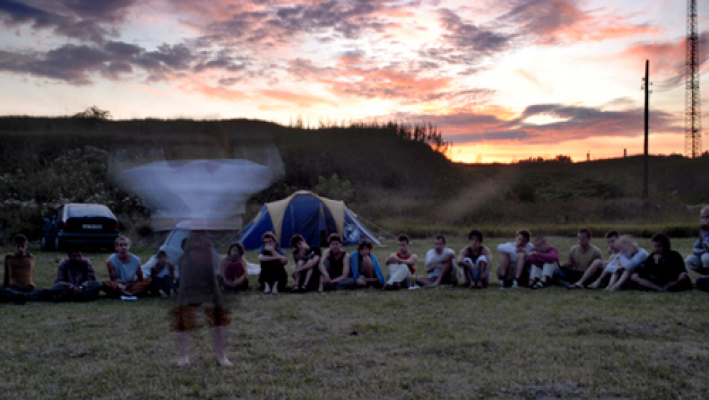
Shacked up in the Star Fort for sixteen days – shacked up next to an open door in the name of “free will”. It’s a strange system of rules that we are dropped into immediately and which we instantly accept from the first. It’s precisely the point that there are barriers here and boundaries, and we must know (how to use) our freedom within these boundaries. For instance: how to exist for sixteen days shacked up here, how to handle the ban on alcohol, whether we complete every exercise or pass on some, whether anyone pushes into the queue to shower, whether we wash the mugs, whether we fall asleep during the evening films, and so on. These are each small tests, small decisions, small “issues”; our responsibility. Strange game, and it only becomes clear later how much harder it is not to go out next to open doors, under the continual intonation of “free will”, than if we were really locked up. Then we’d have to rebel, we would feel deprived of something, then the school camp mechanism would be triggered: climbing the fence and playing truant. As it is we don’t even miss the outside, nor alcohol particularly. These are accepted rules of play.
The second day’s many hour-long silence teaches us precisely that. And then it turns out that everything’s much more refined, much more “cunning”, than it seems at first. How often is it that I feel I’ve long understood the task Süsü is still outlining, and then it turns out I don’t. Or at least that it’s not enough to understand it with my brain – that realisation requires much more. For instance patience and concentration. This is already clear by the third day, when we watch through all seventy people’s introductory performances, inspired by the hours spent in silence or our first memories. As I search, quite fresh memories emerge alongside the tattered ones, and I realise how small a segment the present is in actuality, how small a unit of time, since everything instantly becomes past, that is memory. This is what my performance is about too – slightly timid attempt. Then there is the dissection; we sit in a circle and one by one everyone is discussed. Another game of patience. We grow tired: almost everyone half nods to sleep, we go out to smoke more, then we manage another slice of bread with jam or a little cheese with tomato. Süsü is motionless, speaking from start to finish about everyone with the same attention and intensity. Meanwhile out there it storms, the tent leaks in more than one place, we huddle and move the luggage here and there, water from above and the side too. Absurd. But then good weather comes too, perhaps too strongly – heatwave alert – we traipse about all day wet-headed, or immersed in our artificial Adriatic.
Individual tasks continue, the concentration begins, and formal continuity grows too. I stand under the beating sun in the tall grass by the camp and try to find the form appropriate to my philosophical prompt. No luck. I shuffle around, pace up and down. Then I show something, which I know from the first minute isn’t good. Süsü doesn’t think it works either. I keep trying; at night another rendition, even worse. I can’t accept passing on the task. Cramping up, loss of assurance, it becomes harder to perform, I grow tense around the others. Meanwhile I do want to do it, and wouldn’t even think of going home: I’m just having trouble with myself. And the mess grows bigger, dirty clothes crumpled in piles at the sides of the tent, at night great flashlight operations to find contact lens fluid. Sometimes we make campfires even after the evening screenings, though usually the day so exhausts us we collapse in the tent instead. Since the work begins at 9 in the morning, and before that we have to eat breakfast and wash. Everyone finds their technique for showering, and after a few days we sit with the same people in the queue for the showers, sipping coffee.
Then with the group tasks I get over the anxieties. It’s good to think together with others; they inspire me. The method is always the same: rehearsal, presentation, analysis – be it Anger, be it the Longing or Hyperreal task. The groups generally work well, and are varied with every task. I only have one awful day and a half, then the thought of going home really crosses my mind. There are low points, individual and global exhaustions. “Now somehow we should be able to leap forward, because we’re at an impasse.” – I tell Zsolt Nagy, who comes down for a few days. “What impasse are you talking about?” – he asks – “You’re only doing this for sixteen days, you’re only in this until then.”
And indeed that is exactly what’s tough. That for two weeks Süsü offered us an opportunity, showed us a path, that this too is possible. Máté Gáspár came down too, there was talk of Krétakör’s sometime incipience, we got entangled in application possibilities, and the question of structure. And now we must be able to do something with everything, the perspective, the energy which we’ve gained. Use them well after the camp, when we return to college, to Kaposvár or Marosvásárhely.
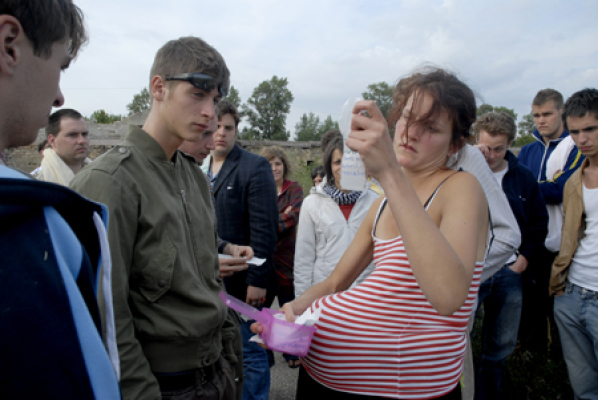
And the last day’s exercise is determining too: leaving the fort, using what we learned in the camp, and creating performances for people. There are those who are uncertain and rejecting, those who are successfully convinced, and there are those who are already ready to take part in the game. But the most important: that “finally something is happening in this boring town” – someone says. That we gave, and could put ourselves to test. We have something beside the tent and the backpack to lug home after these two and a half weeks. Thank you.


Photos: Krétakör Archives