
Thália Theatre
www.thalia.hu
Premiere: 27. 03. 2002.
Leonce és Léna
(Leonce and Lena)
THEATRE | A production of Krétakör Theatre
Budapest (HU) | 2002
_5c66b4923feb6.jpg)
This play by the genial German author (who died young in the first half of the XIXth century) with its fresh, free, playful tone common in the literature of the Romantic-Biedermeir age has been regularly performed on the world’s stages from its premiere through modern times. The play deals with the basic problems of individual and social existence in a fairytale-like, seemingly facile form: who are we, why and how should we live, whether we have to give up our freedom to become integrated into society, do we have to give up love for family life, and independent thought to become useful members of society?
This piece takes place in the realm between reality and dream, our true self and the roles we play in the world, fate and free will. It is performed by Krétakör in a minimal playing space, a Persian carpet of 3 x 4mts, in intimate and sometimes grotesque proximity to the audience, which is seated around three sides of the carpet.
Written by Georg Büchner
Hungarian translation: Gábor Thurzó
Using excerpts from Shakespeare's 'Hamlet', 'Romeo and Juliet', 'As You Like It', and Büchner's 'Woyzeck' and 'Danton's Death'.
CAST
Prince Leonce, Crown Prince of Popo: Gergely Bánki
Princess Lena, Crown Princess of the Kingdom of Pipi: Lilla Sárosdi
Valerio: Roland Rába
Rosetta/ Governess: Borbála Péterfy
King Peter, Ruler of the Kingdom of Popo: Sándor Terhes
Marshal: Annamária Láng
President: Zsolt Nagy
Directed by Árpád Schilling
Scenography by Márton Ágh, Tamás Bányai, Áron Kovács, Róbert Noszlopi
Music by András Monori
Costume design by Klára Varga, Julcsi Kiss
Dramaturgy by Péter Kárpáti, Anna Veress
Drama pedagogy consultant: Erik Szauder
Puppetry consultant: András Lénárt
Assistant to the director: Balázs Erős
Production manager: Máté Gáspár
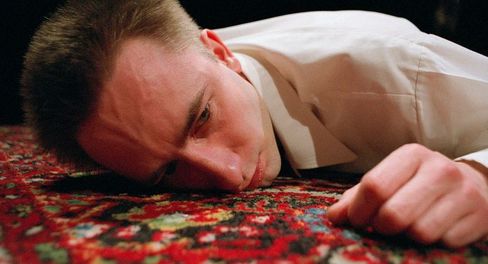
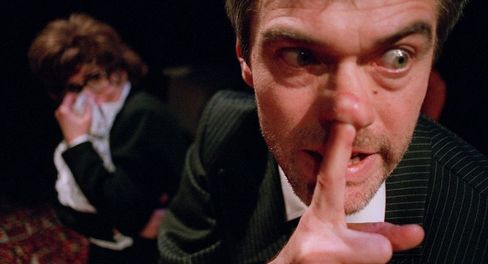
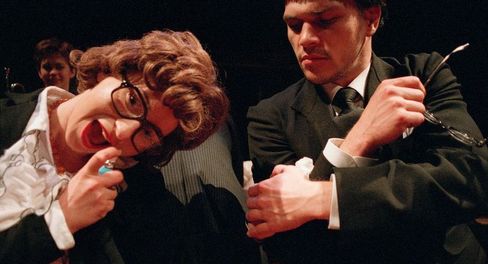
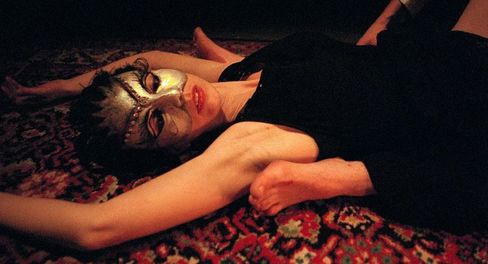
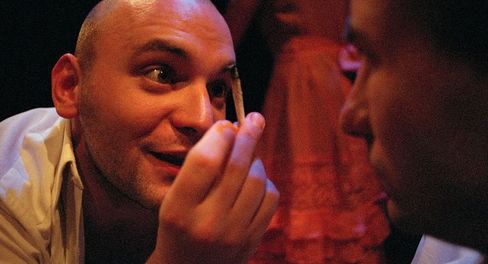
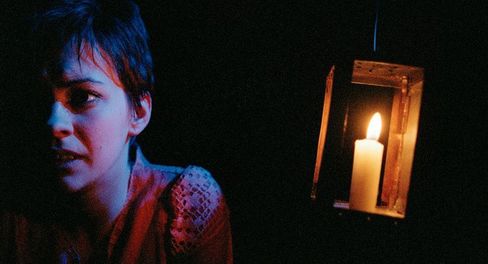
Photo: Mátyás Erdély
PRESS
- Tamás Koltai: Üresség mint reália és metafora. Élet és Irodalom, 12. 04. 2002.
“This country is like a Persian carpet” - Leonce says; in this way the Persian carpet laid on the ground defines the playing area.... The association of ideas work well: for Büchner also, the empty space can be interpreted metaphorically as the emptiness of the world and the inner world of the characters, which manifests itself in boredom and doing nothing. From this, it takes only one step to arrive at the current basic idea of Schilling’s theatre, the crisis-drama that perceives the emptying of the world as a shortfall, desperation and conflict. […] Schilling’s achievement is that his actors build from themselves, from their inner contents, he is not a philosophical personality character, but the text-meditation inspired by personality gains philosophical depth.”
_5c66bbee8187e.jpg)